In a major victory for housing activists, the Constitutional Court of South Africa has declared the R135m sale of the former Tafelberg School site in Sea Point to a private buyer unlawful. This brings a decade-long legal battle over one of Cape Town’s most contested pieces of public land to a close.
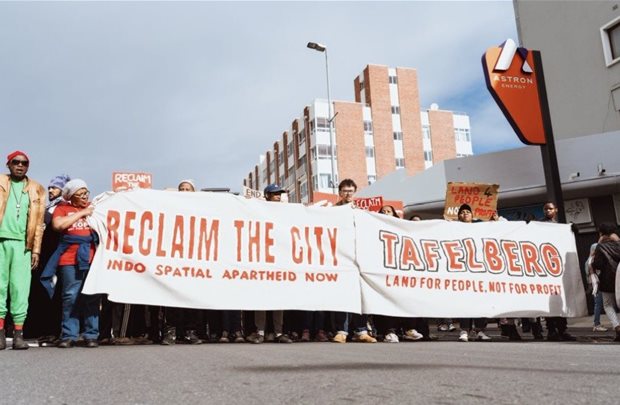
Source: NdifunaUkwazi/@NdifunaUkwazi
The ruling is expected to become a key reference point in future disputes involving public land, housing rights and spatial justice, reinforcing the principle that the disposal of state assets must be assessed against constitutional obligations to address inequality.
The High Court has directed the Province and the City to file reports within three months outlining their current policies, projects and programmes for providing affordable housing on the site and in the CBD.
The reports must include a schedule of completed and ongoing projects, details of expenditure, and whether national funding has been requested. They must also set out any intergovernmental co-ordination.
The court has granted leave for further affidavits to be filed and to allow the matter to be re-enrolled in the High Court if necessary.
The ruling overturns the 2015 provincial decision to sell the 1.7ha site to the Phyllis Jowell Jewish Day School at 355 Main Road, Sea Point – a provincially owned property. The deed of sale was concluded in January 2016.
The site has stood vacant since 2010.
A private Jewish day school, the Phyllis Jowell Jewish Day School currently operates from its campus in Camps Bay.
Location matters constitutionally
The transaction sparked immediate legal challenge from housing advocacy organisations Ndifuna Ukwazi and Reclaim the City, whose leaders argued that the disposal of well-located public land would entrench apartheid-era spatial inequality by limiting access for lower-income households to centrally located economic opportunities.
"The government must take location into account when planning housing projects, as the City and the province have a constitutional duty to reverse “patterns of exclusion”," the court ruled.
“Location is not a peripheral consideration in housing policy. It is integral to the reasonableness inquiry,” Justice Nonkosi Mhlantla said in the unanimous ruling.
Public participation invalidated
Over the past decade, the dispute has moved through multiple courts. In 2020, the Western Cape High Court ruled the sale unlawful, finding that provincial authorities had failed to properly consider their constitutional obligations to address spatial inequality and expand access to housing.
That ruling was later overturned by the Supreme Court of Appeal, prompting the matter to be escalated to the Constitutional Court.
The apex court has now found in favour of the applicants, restoring the High Court’s finding that the sale was unlawful and reinforcing the constitutional duties of the state when disposing of public land.
It also found that the provincial government breached its co-operative governance obligations by failing to notify and consult the national Minister of Human Settlements about its plan to dispose of the Tafelberg site.
The court also ruled that the regulations under the Western Cape Land Administration are unconstitutional insofar as they allow public participation only after a valid contract for the sale of state land has been concluded.
It suspended this declaration of invalidity for 12 months to give the Province time to correct the legislative defect.
Beyond paper plans
Meanwhile the judgment has directed the City of Cape Town and the Western Cape government to set out their broader inner-city affordable housing plans in reports to be submitted to the High Court.
While the Western Cape government has previously indicated an intention to pursue affordable housing on the site, no final development decision has been made. Justice Mhlantla noted that several projects had been abandoned or stalled for more than a decade.
“Paper plans do not amount to constitutional compliance,” she said, and high market value or land scarcity – which were legacies from apartheid — were not excuses for the City and the Province to evade their constitutional duties.
While there may be budgetary constraints, the Province and the City had to take “reasonable steps” to overcome these, including seeking national government funding, Justice Mhlantla said.